Finland’s forest model draws global praise from visiting FAO director
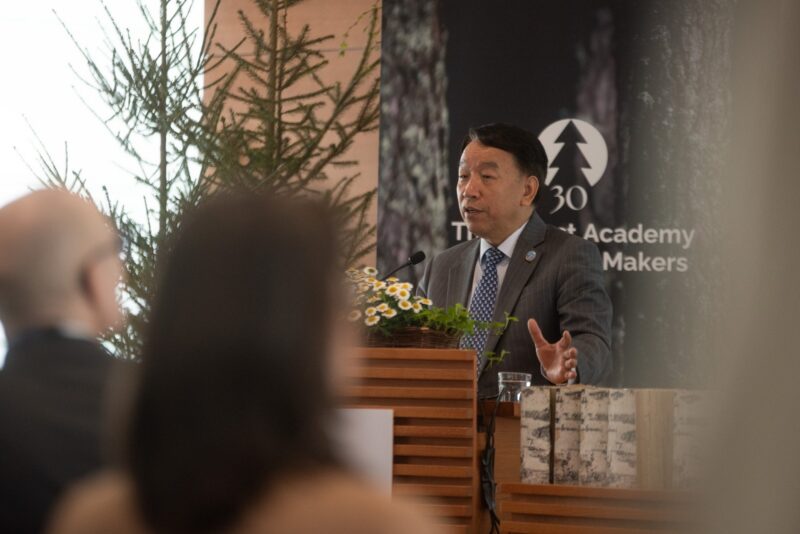
Finland’s approach to managing its vast forests is emerging as a global benchmark for sustainability, says Dr Zhimin Wu, Assistant Director-General and Director of the Forestry Division of the Food and Agriculture Organisation of the United Nations (FAO).
Speaking at a media event at the House of the Estates, in Helsinki, during his three-day visit, Dr Wu described Finland as a global frontrunner in sustainable forest management, highlighting practices that offer lessons beyond its borders.
“This trip has been an intensive learning experience,” Dr Wu said after meeting high-level policymakers, researchers and industry leaders.
“Three key impressions in particular stand out: sustainability, collaboration, and innovation.”
A leading forest nation
Dr Wu’s first takeaway is that Finland is one of the world’s most significant forest countries. With 75% of its land covered by forests—the highest forest cover in Europe and one of the highest globally—Finland combines extensive forest resources with long‑term stewardship.
Finland’s forests also grow more each year than the amount of timber harvested from them, which is the fundamental principle of sustainable use.
While deforestation and forest degradation remain a major challenge in many parts of the world, Finland’s model shows how forests can be managed sustainably to bring into full play their multiple functions.
Dr Wu also pointed to a shift in global forest policy thinking. While the world has experienced shifting focus on the productive and protective functions of forests before and after the 1990s, a balance approach has been widely acknowledged in recent years.
Finland, he notes, demonstrates that economic use and environmental sustainability can go hand in hand.
“If people don’t see the value of forests, they won’t protect them,” Dr Wu told Forest News. Finland’s system of roughly 600,000 private forest owners, he added, has helped align economic incentives with long‑term sustainability goals.
Governance built on consultative and participatory multistakeholder engagement
The FAO director’s second observation focused on Finland’s consultative and participatory governance model.
“In many countries, forest governance is largely government-driven,” Dr Wu said.
“In Finland, it is genuinely participatory and inclusive.”
He pointed to Finland’s broad and well-coordinated network of actors involved in shaping forest policy and practice, noting that success is likely built on multistakeholder engagement involving public authorities, ministries, research institutions, forest owners, and industry organisations.
“Instead of putting decision-making in one place, Finland shares responsibility among different stakeholders. The government provides strategic direction and required support, while other actors handle implementation and operation in practice.”
He also highlighted Finland’s forest dialogue platforms, especially the Forest Academy for Decision Makers which plays an important role in strengthening information exchange among decision makers and forestry experts. .
At the same time, organisations such as the Central Union of Agricultural Producers and Forest Owners (MTK)—a national association that acts as a lobby group and support network for Finnish farmers and private forest owners—and regional forest management associations ensure that private forest owners’ views are represented and supported in everyday forest management.
According to the FAO Director, this multi-stakeholder approach enhances both the legitimacy and effectiveness of forest governance. It ensures that policies are grounded in practical experience while also involving those responsible for implementation throughout the process.
“This shared responsibility is likely a key factor behind Finland’s success in sustainable forest management.”
Innovation powers the bioeconomy
The third major takeaway from Dr Wu’s visit is Finland’s strong leadership in forest-based innovation. He stressed that, with global demand for wood and forest-based products expected to rise significantly, the need for sustainable and innovative production is becoming increasingly urgent.
“Sustainable bioeconomy will be one of the key pathways to achieving a sustainable future,” Dr Wu said. “Here, Finland is clearly at the forefront.”
The forest-based bioeconomy is also a priority in the FAO roadmap, which focuses on sustainable production and consumption, more efficient value chains, and promotion of climate-resilient agri-food systems.
During his visit, Dr Wu toured facilities showcasing the expanding bioeconomy, including engineered wood products such as cross-laminated timber (CLT) and laminated veneer lumber (LVL), which are increasingly used as low-carbon alternatives to steel and concrete in construction.
“These materials represent a technological leap,” he said. “They are strong, lightweight and increasingly competitive as a biomaterial.”
He also pointed to the rapid transformation of the sector.
“When we continue talking about conventional forest products like fibreboard,” he noted, “entirely new bio-materials have been emerging and reshaping construction and manufacturing.”
Beyond construction, Finland is also advancing innovation in packaging, textiles and other renewable materials. This demonstrates how sustainably managed forests can underpin a modern, low-carbon economy.
Lessons for the world
Dr Wu noted that although Finland’s model cannot be directly copied, its principles are widely relevant.
“There is no one‑size‑fits‑all solution,” he said. “But sustainable forest management, clear value of the forests, community engagement, multistakeholder involvement and inclusive governance are common to all countries.”
He also highlighted Finland’s long-standing tradition of sharing expertise internationally, through bilateral cooperation and multilateral fora.
“Finland is already setting a strong example,” he concluded. “But it is also continuing to learn and improve—and that is perhaps the most important lesson of all.”
“Finland is not only managing its forests well,” Dr Wu said. “It is helping to define what the future of forestry can look like.”