Bank of Finland Governor Olli Rehn: EU treaties should include specific provisions on forests
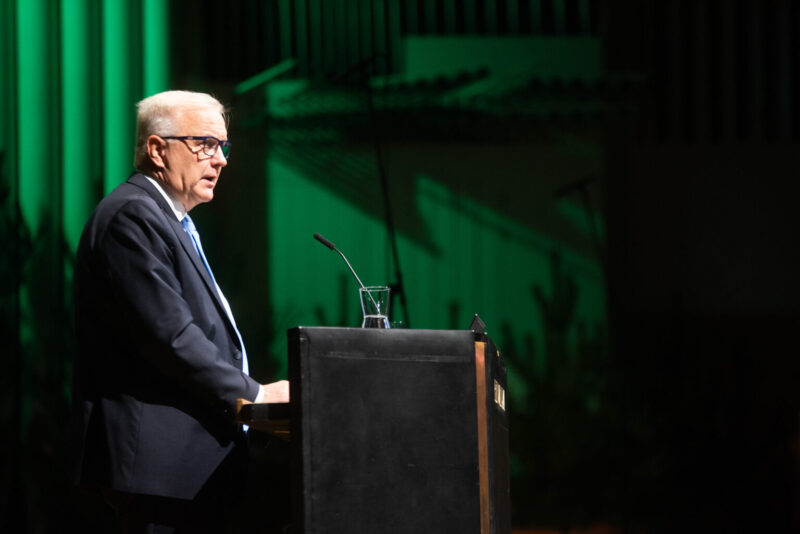
Olli Rehn, Governor of the Bank of Finland and former Vice-President of the European Commission, wishes to encourage debate on specific provisions on the role of forests. The treaties forming the basis of EU legislation contain no mention of forests.
“The European Union passes a great deal of legislation with an impact on forests and their use, yet the Union has no common forest policy, nor is there an expressed legal basis concerning forests,” says Olli Rehn, Governor of the Bank of Finland.
“Even though forests are an extremely important natural resource for Finland and Europe, significant for both the economy and nature values, decisions with an impact on forests are made via other policy sectors,” Rehn says in an interview with the media agency Audiomedia.
Rehn points out that many Commission initiatives related to forests are based on the EU’s competence within environmental or climate policy.
“Forest policy is made indirectly. On paper, national competence within forest policy appears strong, but in practice, forests are impacted by the provisions on the environment. This leads easily to the result that economic aspects, which are important for Finland and other forested countries, receive less attention.”
Rehn is known for having served as the Commissioner in charge of EU enlargement in the Barroso Commission in 2004–2009 and as Commissioner for Economic and Monetary Affairs and the Euro in 2010–2014. During the latter period, he also served as Vice President of the EU Commission.
In Rehn’s opinion, during his time as Commissioner forests were still viewed from the perspectives of environmental policy, agricultural and forest policy and industrial policy.
“This was in line with the principle of sustainability, which strives to harmonize ecological, economic and social goals,” Rehn says to Audiomedia.
Rehn’s solution to the problem is to include a specific provision – a ‘forest article’ – in the EU treaties. He opened the discussion on such an article’ in March this year, by publishing an opinion piece in the daily Maaseudun Tulevaisuus, jointly with Reijo Kemppinen, former Director-General at the European Council.
Strategic resource for Europe
The significance of forests in terms of economy, industry, energy systems and regional development has, in Rehn’s opinion, received too little attention.
“Forests should be viewed comprehensively as a strategic resource. A ‘forest article’ would ensure that the various significances and aspects related to forests are taken into account in a more balanced manner,” Rehn says.
He stresses that he does not propose the ‘forest article’ as a means of diminishing national competence or of constructing a new, centralised EU forest policy. He sees the provision as a means of creating a defined framework within which forests are recognised as a specific strategic entity.
“A ‘forest article’ would mean that forests are comprehensively taken into account when preparing EU decisions. They would be viewed as a strategic resource, harmonising the perspectives of economy, industry and the environment in a balanced way,” he says.
“The debate on updating the forest policy is also actual because the EU enlargement and developing the Union’s functional capability are likely to require a re-examination of the Treaties in future years. If the treaties are to be amended in any case, the issue of forests should also be discussed at the same time.”
Rehn stresses that forest debate cannot be separated from the issue of safeguarding Europe’s competitivity.
“There is currently an extensive debate in Europe on the weakening of its industrial competitivity vis-à-vis the United States and China. From the Finnish viewpoint, forestry and forest industry are part of the solution, not of the problem,” says Rehn, as a representative of the most widely forested country in Europe.
Climate policy should not only focus on carbon sinks
Rehn wishes to particularly highlight climate policy as a sector impacting the use and roles of forests in the EU. He stresses that the ultimate cause of climate change is the use of fossil fuels. He has reservations concerning a policy that sees the achievement of climate goals as relying primarily on restrictions on felling volumes.
Rehn takes up the replacement of fossil materials with wood-based ones. He sees that this substitution effect is often overshadowed by the debate on carbon sinks.
“When wood is used for construction, textiles, chemical industries or energy production, it can replace fossil raw materials and reduce emissions in other sectors of the economy. This perspective has been pushed to the back seat in debate within the EU.”
According to Rehn, Europe should view its forests with the same seriousness as when speaking of critical minerals, energy or technological know-how.
“Forests are a strategic and critical resource. They improve Europe’s economic and social resilience, provide renewable raw materials and support regional development,” Rehn says.
“This is linked to the debate on Europe’s strategic autonomy. Due to the EU’s strive to reduce its dependence on fossil fuels and imported raw materials, the importance of wood-based raw materials could grow significantly. At the same time, forests afford the opportunity to construct a European bioeconomy relying on our own natural resources.”