AI identifies trees from the air as accurately as the human eye – useful for biodiversity and forestry
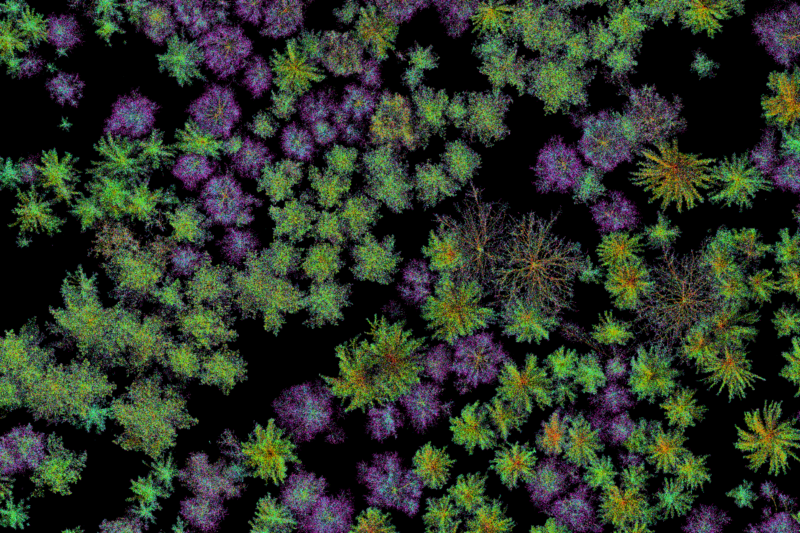
A new remote sensing method identifies the species of individual trees with an accuracy of up to 90 percent. Detailed data on species makes forestry more efficient and improves the monitoring of biodiversity.
Thanks to recent research on tree species classification, it is now possible to identify tree species from the air more comprehensively and rapidly than before. The new method combines multispectral laser scanning with machine and deep learning methods, or, in practice, AI.
The study was conducted by researchers at the Finnish Geospatial Research Institute (FGI) under the National Land Survey of Finland, together with researchers at several universities.
During the past 15 years, forest resources data, describing the structure and tree species of forests, has mainly been generated using a method based on laser scanning, aerial imaging and field measurements.
“Among these, aerial images that combine the wavelengths of visible light and near-infrared have produced data on tree species which has not been available using conventional laser scanning, as it only relies on one wavelength. This is why aerial imaging has played a significant part so far,” says Markus Holopainen, Professor of Geoinformatics at the Department of Forest Sciences of the University of Helsinki.
The more advanced, multispectral laser scanning method measures several wavelengths, in the same way as aerial imaging. This means that more detailed data can now be generated by laser scanning alone.
“With multispectral laser scanning the accuracy of tree species classification comes very close to that of aerial imaging. In the future, forest inventorying might not require both laser scanning and aerial imaging. Instead, one measurement can give both sets of data,” Holopainen says.
Exceptional scope of study on tree species classification
“In remote sensing, AI methods can produce data similar to that perceived by the human eye. Like humans, deep learning can identify a tree species even if the shades of colour between individual trees vary across an image or a data set.”
The new method developed by the FGI and the universities combines multispectral laser scanning with machine and deep learning, thus further improving the accuracy.
Deep learning is capable of rapidly and efficiently combining complex data, such as the shape and geometry of trees and the reflections of different wavelengths of trees.
Holopainen says that the study is one of the broadest among research on tree species classification even on an international scale, focusing on multispectral laser scanning and the development of laser scanning methods.

Improved identification of less common species
The new remote sensing method reached the best accuracy of species identification with 3D laser scanning data that was extremely dense; that is, containing plenty of measurement points. In such data, deep learning helped identify nine species: pine, birch, spruce, aspen, rowan, alder, oak, lime and maple. These trees were identified at an average accuracy of 92 percent. The accuracy of identification improved even when the data was less dense.
The most common species in Finnish forests, including Scots pine, Norway spruce and silver and downy birch, were identified with a very high accuracy, while the identification of less common broadleaved trees was more difficult.
Nevertheless, compared to conventional methods, the deep learning models also essentially improved the identification of less common species.
The challenge, according to Holopainen, is that with the presence of several different species the method becomes less accurate.
“Forests in Finland and the other Nordic countries have a relatively narrow range of species, but as you move to Central Europe or other regions with a wide range of species, identification soon becomes more difficult.”
Remote sensing also becomes more difficult if the trees overlap each other or the forest contains plenty of different layers.
“The denser the stands are, the more challenging the forest is to classify. The method works best in mature commercial forests that have been thinned,” Holopainen says.
Benefits to forestry and biodiversity protection
The identification of tree species is important for both forestry and biodiversity. Accurate data on species improves the planning of timber harvesting, harvest operations and timber trading, for example, all of which improves the productivity of forestry.
The new AI-based method also improves the identification of species essential for biodiversity, such as aspen, as well as the monitoring of changes in the mix of species.
“In order to work well, the machine learning methods used in our study require plenty of learning material, whereas the deep learning methods can work with less. Both methods work better as the areas on which they are used grow in size,” Holopainen says.
Items such as dead trees or forest damage sites can be identified with good accuracy using aerial and satellite images, but deep learning can improve the accuracy even here.
“With a more efficient monitoring of damage sites, more detailed measurements by drone or on terrain can also be made more rapidly, making it possible to detect bark beetle damage, for example.”
Fieldwork will still be needed
With species identification and remote sensing technologies becoming so accurate and automated, will you need to visit the forest at all?
“Deep learning methods do reduce the need for field visits, but they don’t necessarily eliminate it completely. In the forest resources inventorying by the Finnish Forest Centre, information on species is just one of the roughly one hundred items. And to determine most of these you still need measurements in the forest itself,” says Holopainen.
On the other hand, if the purpose is only to identify species that are rare and important for biodiversity, or to find out about deadwood, the new method is sufficient, says Holopainen.
“However, the deep learning models need material to learn from. The generating of this material is fairly slow, since the visual classification of trees still relies on humans.”