Artek purchased a mixed forest estate in Finland and shares experts’ views on continuous-cover silviculture
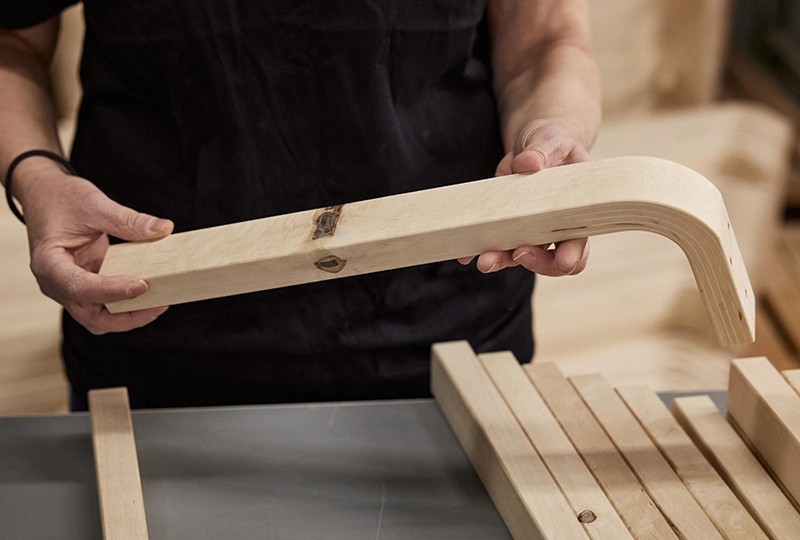
Artek’s furniture can only be made from northern-grown silver birch, and the company’s own continuous-cover silviculture forest helps meet that need. However, continuous-cover silviculture is not suitable everywhere, and the company is aware of this.
The design company Artek acquired a mixed-forest property in Heinävesi to meet its raw-material needs. The wooden furniture designed by world-renowned Finnish architect Alvar Aalto is made from domestic, A‑grade silver birch.
“We get the best quality raw material from mixed forests, from birch trees that have grown for 50–80 years with as few branches as possible,” says Artek’s product manager Riku Rehell.
The company’s goal is to acquire 200 hectares of forest in the future, which will be enough to cover about one-tenth of its birch needs. The forest area is roughly equivalent to some around 300 soccer fields.
“Despite having our own forest land, we are still quite dependent on other forest owners whose mixed forests contain silver birch.”
Artek is a well-known design company founded in 1935 to market and sell furniture, lighting, and textiles designed by Alvar Aalto (1898–1976) and his wife Aino Aalto (1894–1949), particularly for global markets.
Artek needs light-colored birch
Artek uses about a thousand cubic meters of birch wood each year, and its business depends on a steady supply of high‑quality raw materials. Most of the company’s furniture is crafted from exceptionally light‑colored and durable birch that grows only in northern forests, where the short growing season gives the wood its distinctive properties.
At the same time, climate change has altered forest growth and wood quality worldwide.
According to the company, silver birch accounts for only four per cent of all tree species in Finnish forests. In mixed forests, birch sprouts naturally as a pioneer species and grows tall and straight as it reaches for light.
What is a mixed forest? Mixed forests are defined in different ways depending on the country. In Finland, they are defined as forests containing at least two tree species, with the share of no species exceeding 75 percent. The corresponding maximum percentage in Sweden is 65.
Continuous cover forestry is not an universal solution
Artek plans to manage its forests using the continuous‑cover silviculture method. In continuous-cover forestry, trees are harvested selectively. By leaving more trees standing—including deadwood—Artek says it can safeguard biodiversity more effectively than with periodic forest management, which typically ends with a final clear‑cut. In periodic silviculture, the rotation period of the trees largely concludes with a regeneration felling.
The company considers the economic viability of continuous cover forestry to be “encouraging.” Artek aims to demonstrate that the method is both technically and economically feasible and hopes other Finnish forest owners will follow suit.
Experts emphasise, however, that continuous cover forestry is not a one-size-fits-all solution. The method works best in certain growing sites, such as fertile peatlands, but not everywhere.
“We share the same view (as the experts) that the continuous cover forestry method works better in certain types of forests,” Rehell explains.
Artek, together with its partners, is now looking for mixed-forest estates whose soils are best suited to the continuous-cover silviculture method. Aalto furniture is still manufactured in Finland, using timber sourced from 50–80‑year‑old domestic birch trees.
According to the company, some of its products are even carbon‑negative. This means that over their lifetimes, they store more carbon removed from the atmosphere than is generated during their production.