Shimmering wood that decomposes in the forest – commercialisation of a nanocellulose-based method is already underway
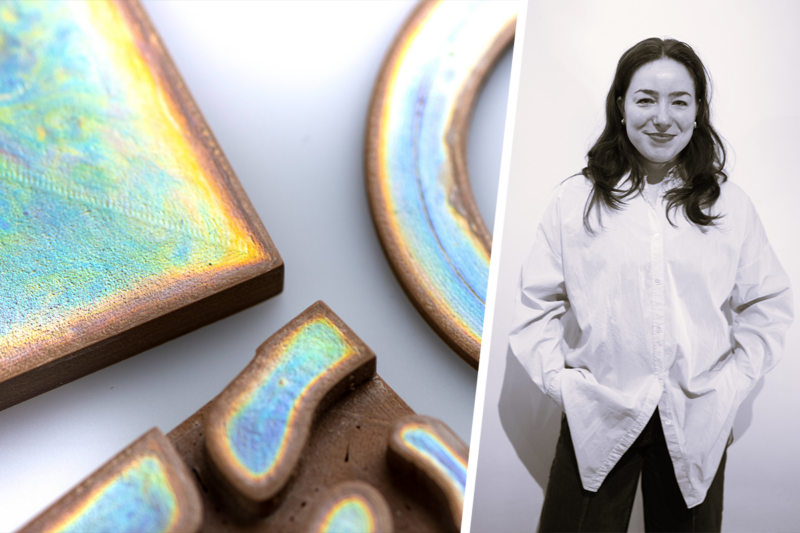
As part of her doctoral research, Noora Yau developed structural colours from wood. The method is already being commercialised internationally.
With microplastics posing a global problem, and the EU banning loose plastic glitter, Noora Yau addressed the persistent demand for sparkle by focusing her dissertation on creating structural colour (CNC SC) from wood-based nanocellulose.
“We found a way to coat a wooden surface with shimmering, wood-based structural colour. Even though the wood shimmers, it is still 100% wood that decomposes naturally,” Yau explains says in a press release by the Finnish Natural Resources Research Foundation.
Noora Yau completed her dissertation, Shimmering Wood – Experimenting with Nanocellulose-Based Structural Colour, at the School of Arts, Design and Architecture at Aalto University. Her research partner was materials scientist Konrad Klockars.
Yau developed a method for producing shimmering, iridescent colour-shifting effects from wood-based materials. Traditionally, similar colours have relied on non-renewable resources such as plastics, metals, and even lead — a well-known environmental toxin.
We found a way to coat a wooden surface with shimmering, wood-based structural colour. Even though the wood shimmers, it is still 100% wood that decomposes naturally.
In nature, similar colours can be found on butterfly wings, peacock feathers, or beetle shells. The structural colour visible to the eye arises from the interaction between light and the nanostructure.
The wood-based colour results from breaking down wood into nanocellulose particles, which self-organise into a nanostructure that produces a shimmering effect.
As a designer, Yau brought insight into the material’s potential and aesthetics and developed the shimmering wood through various experiments and applications.
“From a design perspective, I considered how the colour could be utilised in the built environment. As a designer, I can identify aesthetic and visual phenomena. These phenomena can be difficult to define from a technical perspective, because measuring them with qualitative methods is not necessarily meaningful,” Yau said.
Yau also standardised the vague terminology of structural colours for designers and artists.
“What does a term like ‘metallic colour’ actually mean? Does it mean that the colour contains metal, or that it shimmers? And besides, there are so many different kinds of metals. I aim to clarify the ambiguities in terminology and define things to avoid misunderstandings. Clarifying terminology was important so that designers could participate in the conversation and access research-based knowledge about colour. Discussion and interdisciplinary research work best thanks to a shared vocabulary.”
Design found its own way of operating
How did Helsinki native Noora Yau become an award-winning doctoral researcher? Although she doesn’t see herself as particularly academic, her studies at Aalto University shaped her approach to academia.
“I’ve always been good with my hands and drawn to the arts. While I was an average student, I excelled in music and art. I even applied to the Academy of Fine Arts, though it’s fortunate I didn’t get in.”
A turning point came when Yau was hired as an assistant to sculptor Pekka Paikkari at the Arabia ceramics factory.
“Upstairs we made art, and then we’d take the elevator downstairs to watch the Moomin mugs go into the kiln. That experience sparked my passion for design.”
After being accepted into Aalto University to study glass and ceramic design, Yau experienced what she describes as a “minor identity crisis” during her master’s studies, realising she no longer wanted to contribute to producing more consumer products.
At the same time, she knew she had loved shimmering colours and glitter since childhood.
After hearing about nanocellulose-based structural colours researched at Aalto University, Noora Yau then contacted Orlando Rojaks, a respected professor at the Department of Bioproducts and Biotechnology.
“I told Professor Rojaks that I wanted to use glittery colours. He was enthusiastic and told me to come over and do it. He then gave me chemical engineering texts and told me to start learning to work in the lab.
In the laboratory, experiments and setbacks followed one another. Eventually, with support from others, Yau managed to produce a rainbow-like edge effect in a single sample. A major breakthrough in the process was the realisation that research does not have to be a solitary effort. Materials researcher Konrad Klockars joined the project, and the collaboration created a dialogue between technical precision and aesthetic exploration.
As a designer, Noora Yau realised, for example, that the so-called coffee-ring effect of shimmering colours is not necessarily a flaw but can also be a desirable feature to be utilised.
“Previously, people wanted to get rid of the rainbow-colored ring without evaluating its visual dimension. Instead, the goal was to create a nanostructure as uniform as possible that could, for example, accurately reflect the technical system of an electronic sensor. In this context, the colour’s appearance is irrelevant; what matters is how it functions technically. But when we looked at the wood-based structural colour from a completely different perspective, we found that a whole new world opened up for exploration. What can wood-based structural colour look like in a built environment?”
Yau realised that the rainbow-like ring, previously considered a defect, could be used as an effect that enhances the shape of the colored surface.
Environmentally friendly glitter goes commercial
There is a need for renewable and eco-friendly glitter, as the European Union has banned the sale of loose plastic glitter. Microplastics are an ever-growing global problem.
After completing her dissertation, Noora Yau founded Shimber Ltd. to commercialise shimmering wood into high-value-added products.
While working on my dissertation, I received a lot of inquiries from various industries, such as fashion companies, the architecture sector, and the automotive and furniture industries.
“While working on my dissertation, I received a lot of inquiries from various industries, such as fashion companies, the architecture sector, and the automotive and furniture industries.”
Yau states, “Shimber already invoices international clients, and patenting processes are underway. Our mission is to develop high-value products that last and endure, rather than being quickly discarded.”
“We consider wood a valuable material, and we want to continue emphasizing its value. If wood is used, it should be used properly. I want to contribute something good to the world in my own way, and this is the way I know how to do it.”
Noora Yau was awarded the Foundation for Research of Natural Resources in Finland (Suomen Luonnonvarain Tutkimussäätiö) dissertation prize for her work in spring 2024. The foundation grants the ten-thousand-euro award annually to encourage young researchers focused on the sustainable use of Finland’s natural resources.