Transport entrepreneur switched to low-emission biogas: “We want to show that we’re already on the move.”

Liquefied biogas (LBG) aligns naturally with circular bioeconomy strategies worldwide, particularly in forest-rich regions such as the Nordics. LBG can be produced from forest industry sidestrems—such as wood chips, sawdust, and bark—transforming residual biomass into clean, renewable energy.
Finnish research shows that biogas-powered heavy-duty vehicles perform well on gravel forest roads, which place unique demands on transport equipment. These are precisely the routes where biomass is moved from forests to industrial processing.
Countries like Finland, Sweden, and Norway are pioneers in integrating LBG into their forest-based bioeconomies. In June 2022, Finnish transport company Eskola Ltd. (Kuljetusliike Eskola Oy) launched Europe’s first heavy-duty biogas-powered truck for timber hauling in the Oulu region, operating in service of Metsähallitus—the Finnish Forest Administration, which manages Finnish state-owned forests.
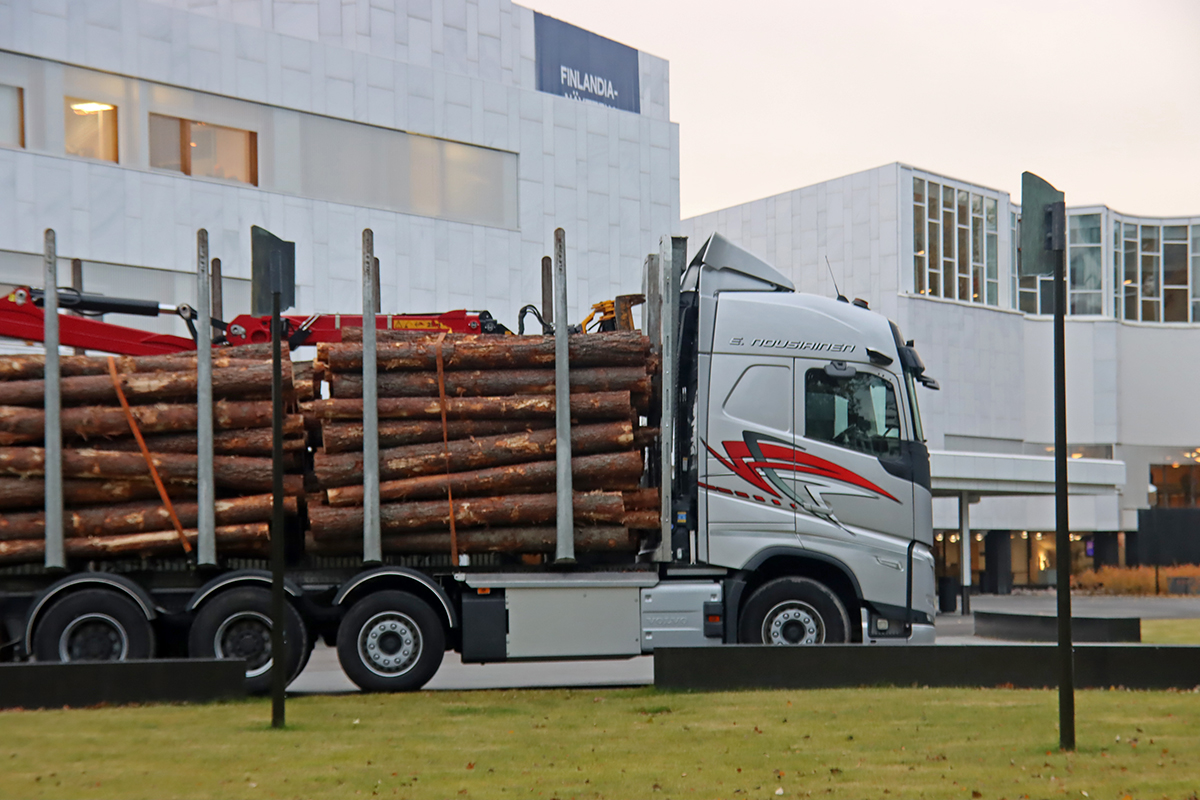
In February 2025, Finland-based haulage firm E. Nousiainen Ltd. (Kuljetusliike E. Nousiainen Oy) added its first liquefied biogas-powered combination vehicle to its fleet and is already planning a second. The investment is supported by a new refuelling station set to open in Riihimäki—within the company’s operating area—by the end of 2026.
“If everything goes according to plan, we’ll roll out our second gas-powered vehicle in early 2027,” says Antti Nousiainen, CEO of E. Nousiainen Ltd. He notes that drivers have consistently praised the biogas truck’s smooth and quiet performance—factors that greatly enhance comfort and job satisfaction during long-haul shifts.
Science backs the shift to renewable fuels in timber transport
Biogas-powered fleets are emerging as a promising solution for reducing emissions in heavy-duty logistics. According to recent studies, biogas-powered vehicles can cut carbon dioxide emissions by up to 90 per cent compared to traditional diesel trucks. They also produce less noise and fewer particulate emissions, easing environmental pressure—particularly in urban areas.
Despite their potential, biogas trucks remain relatively uncommon in forestry logistics across Europe. However, interest is growing, especially in countries with strong bioeconomy strategies such as Finland, Sweden, and Germany.
Research continues to support the transition to renewable fuels also in timber transport. Alongside biogas, several alternatives are being explored. Renewable diesel (HVO), produced from waste and vegetable oils, is already in use and compatible with existing diesel engines without modification. Biodiesel (FAME), while viable, requires blending with fossil diesel, and its suitability depends on the vehicle fleet.
Electric and hydrogen-powered solutions are still in development for heavy-duty forest applications, but experts expect them to complement low-emission transport systems in the future.
According to researchers, liquefied biogas and renewable diesel are currently the most practical alternatives to electrification in reducing emissions from timber logistics. Studies by the University of Eastern Finland and Metsäteho Ltd., a Finnish forest industry R&D company, confirm that LBG-powered vehicles can operate cost-effectively even on demanding gravel forest roads.
Further research by LUT University highlights the importance of route optimisation and load efficiency in reducing emissions. The Tampere University supports this view, noting that innovative route planning tools—especially when combined with biogas—can make biomass transport both more economical and environmentally sustainable.
Biofuel adoption still limited
In September 2025, a survey by the Finnish Transport and Logistics Association (SKAL) revealed that 30% of Finnish transport companies plan to invest soon—but 90% of those investments still go to diesel trucks, while just 13% target gas-powered and 5% electric vehicles.
Several factors contribute to this trend. Biogas-powered combination vehicles are roughly 25% more expensive than diesel models, and the refuelling infrastructure remains sparse in Finland, especially in remote forest regions, Antti Nousiainen points out.
“Drivers often refuel with half a tank just to be safe, since the next station could be hundreds of kilometres away,” he adds.
Fuel prices can also influence investment decisions.
In September 2025, LBG averaged €1.87/litre in Finland, while diesel averaged €1.63/litre. Earlier in the year, diesel cost €1.80/litre and biogas €1.67/litre—a fifth less than today.
Despite recent price shifts favouring diesel, Nousiainen sees biogas as a strategic investment aligned with the climate goals of major forest industry clients like Metsä Group and Stora Enso.
“Our biogas fleet is also a statement. When timber is transported across Finland using biogas, it shows we’re committed to doing things differently.” Our customers expect action—not just promises. We want to show we’re already moving forward.”
Biogas gains ground, but diesel still dominates European freight
Across Europe, the adoption of biogas-powered trucks faces familiar hurdles including higher upfront costs and limited refuelling infrastructure. These factors continue to slow the shift from diesel to renewable fuels in heavy-duty transport.
Still, liquefied biogas (LBG) is steadily gaining traction in transport investment strategies, says Anssi Kujala, CEO of the Finnish Transport and Logistics Association (SKAL). Finland’s national climate and energy strategy also forecasts growth in gas-powered heavy vehicles through at least 2050.
“Liquefied biogas has clearly been more popular than electricity in long-haul and heavy-duty transport,” Kujala notes.

For now, diesel continues to dominate freight logistics. In Finland, 98% of licensed freight trucks still run on diesel, and nine out of ten new vehicle investments are directed toward diesel-powered models, according to the CEO of SKAL.
“Diesel will remain the dominant power source for freight transport well into the 2030s,” Kujala predicts. “But the rise of alternative fuels demands a determined, nationwide expansion of charging and refuelling infrastructure.”
This trend is reflected across Europe, where diesel remains the backbone of long-haul freight operations. However, growing regulatory pressure and increasingly ambitious climate targets are beginning to shift investment strategies toward cleaner technologies.