Europe’s shift toward low‑carbon wood construction accelerates — but progress remains uneven
Europe’s shift toward low‑carbon construction is accelerating, and wood is emerging as one of the continent’s most promising building materials. Yet progress varies widely between countries.
Finland, long known for its forests and world‑class wood‑processing expertise, remains behind its Nordic neighbour Sweden in the volume of wooden apartment buildings — a gap that reflects broader structural differences across Europe’s construction markets.
In Finland, wooden apartment buildings have accounted for between 2 and 4 per cent of new builds in recent years. Meanwhile, in Sweden, the share has already reached 20 per cent, making it one of Europe’s frontrunners in industrial wood construction.
According to Pekka Heikkinen, Professor of Practice in Wood Architecture at Aalto University, the divergence is not due to technical limitations.
“The technological and economic barriers are not insurmountable. The example of Sweden proves that,” says Heikkinen.
Heikkinen argues that Finland has all the prerequisites to become a leader in wood construction: internationally recognised expertise, abundant forest resources, and a strong materials industry. The country is a major developer and manufacturer of engineered wood products such as cross‑laminated timber (CLT) and laminated veneer lumber (LVL), both of which are central to modern industrial building.
These materials are also attracting attention globally. During a visit to Finland in May, FAO Assistant Director‑General and Director of Forestry Zhimin Wu described them as transformative: “These materials represent a technological leap forward,” Wu stated in an interview with Forest.fi.
Industrial Wood Construction Gains Ground Across Europe
The rise of industrialised wood construction is visible not only in the Nordics but also in Central Europe, where countries such as France, Austria, and Germany are expanding their use of engineered timber in both residential and public buildings. Finnish companies are increasingly tapping into this demand.
Punkaharjun Puutaito Oy — named Finland’s 2024 Wood Industry Company of the Year — recently signed its first direct export deal, supplying wood elements from Kerimäki to Sweden. The company is also exploring opportunities in Central Europe, where demand for prefabricated timber elements is growing.
The firm’s CNC‑manufactured elements are particularly suited for apartment buildings and modular construction, a segment expanding rapidly across the continent as cities seek faster, cleaner building methods.
Regulation is becoming a key driver — in Finland and the EU
Europe’s construction sector accounts for roughly one‑third of total emissions, and policymakers are increasingly turning to regulation to steer the market toward low‑carbon materials. Finland introduced carbon‑footprint limits for buildings in early 2025, a move that mirrors similar policy trends in France, the Netherlands, and Denmark.
Heikkinen believes these measures will reshape the market:
“The construction sector will only change when it must. Legislation is the most effective means of steering change.”
Finland’s limits will tighten again in 2029, making low‑carbon materials even more competitive. Wood stands to benefit, as it has a significantly smaller carbon footprint than concrete or steel and stores carbon throughout its lifetime.
Across the EU, regulatory momentum is also building. The upcoming Carbon Removal Certification Framework (CRCF) aims to create technical criteria for calculating and certifying carbon stored in wood products — a development that could further boost timber construction.
Aalto University’s Associate Professor of Sustainable Construction Matti Kuittinen, sees major potential: “According to a study commissioned by the Ministry of the Environment, wood construction has the potential to reduce emissions by as much as twenty percentage points across several different building categories.”
He adds that aligning Finnish building codes with those used elsewhere in Europe could unlock significant domestic climate benefits.
Finland’s showcase projects impress — but scale remains the challenge
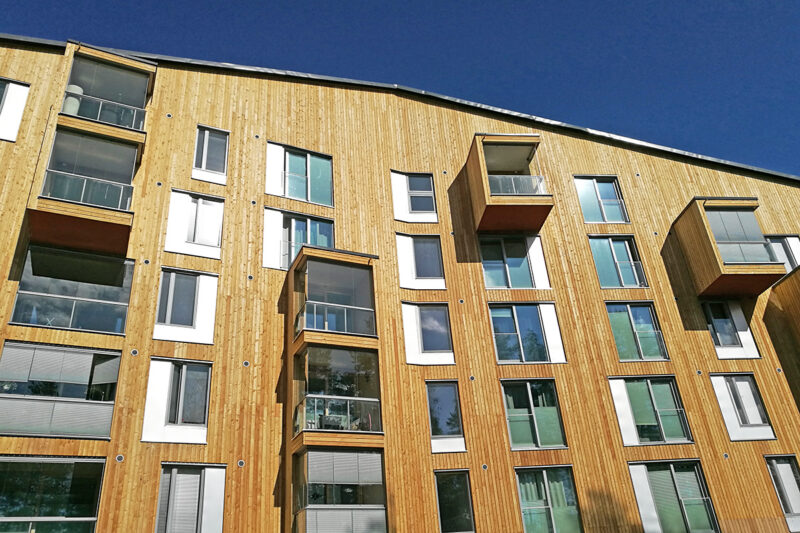
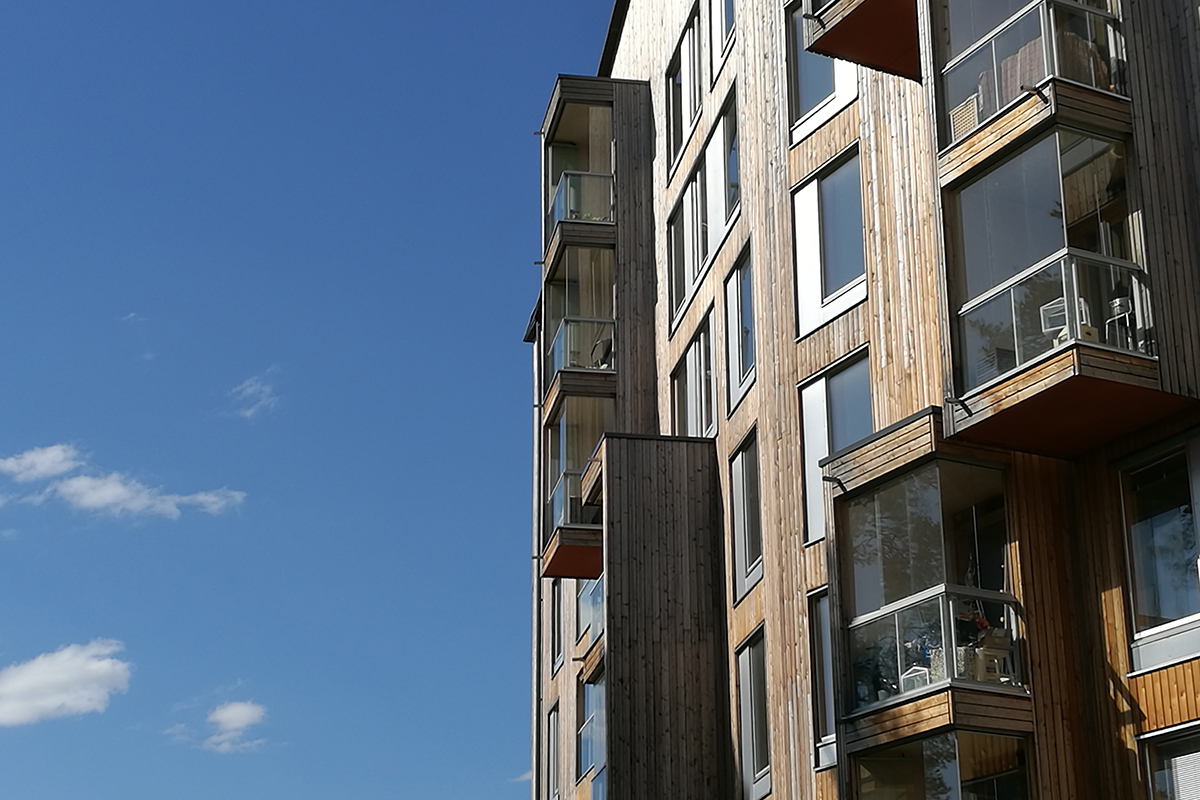
Despite its modest market share, Finland has produced several internationally recognised timber buildings. The Puukuokka block in Jyväskylä — home to Finland’s first eight‑story wooden apartment building — and the Laituri complex in Central Helsinki are frequently cited as examples of world‑class design and engineering.
Professor Heikkinen praises these achievements but notes their limitations:
“In many ways, Finnish wood architecture is right at the forefront of the world. The problem is that these have so far remained isolated projects.”
Pilot projects alone cannot shift national markets or deliver large‑scale climate impact. The key, he argues, is industrialisation.
Industrialisation: Europe’s Competitive Edge
Sweden’s rapid progress is largely due to its highly industrialised construction sector, where prefabricated wood elements and standardised modules dominate. This approach boosts productivity and lowers costs — advantages increasingly recognised across Europe.
“In Sweden, wood buildings are largely manufactured in factories from prefabricated wood elements and standardised modules. This improves construction productivity and lowers costs,” says Professor Heikkinen.
Finland, by contrast, still relies heavily on on‑site construction. A study by Aalto University found that up to 80 per cent of on‑site work is inefficient in terms of advancing project progress — a challenge shared by many European countries with traditional construction cultures.
Heikkinen believes industrialisation could transform the sector:
“Highly industrialised wood construction solutions could significantly improve construction processes, labour utilisation, and the productivity of the entire construction sector, also here in Finland.”
A growing European market for low‑carbon materials
Across Europe, tightening emissions targets are driving demand for renewable building materials. Metsä Wood Business Area Director Jussi Noponen sees wood construction as a major growth opportunity.
“Buildings account for about one-third of global greenhouse gas emissions. The advantage of wood is that it stores carbon throughout the building’s entire life cycle,” he told journalists during a media event at the company’s Äänekoski site in Central Finland.
Noponen also highlighted the productivity benefits of industrialised timber construction, noting that factory-based manufacturing can significantly improve efficiency compared with conventional on-site building methods.
Metsä Group’s new LVL (laminated veneer lumber) plant, scheduled to open in Äänekoski in 2026, is expected to further strengthen Europe’s supply of advanced engineered wood products.
“With this material, the same structural performance can be achieved using significantly less raw material than with traditional construction solutions,” Noponen said.
EU Carbon Framework could be a turning point
As European cities seek scalable, low-carbon building solutions, wood construction is widely seen as part of the transition — with its role shaped by regulation, industrial capacity, and market demand.
According to Matti Kuittinen, the EU’s emerging carbon accounting framework could further strengthen the business case for timber construction. The development is linked to the EU’s Carbon Removal Certification Framework (CRCF), under which technical criteria are currently being developed for quantifying and certifying carbon stored in durable wood products.
Kuittinen argues that, for Finland in particular, the framework could be significant:
“Finland should actively influence this process both within the EU and by reviewing its own construction legislation.”