Forests need fire too: how prescribed burning restores biodiversity in Finland
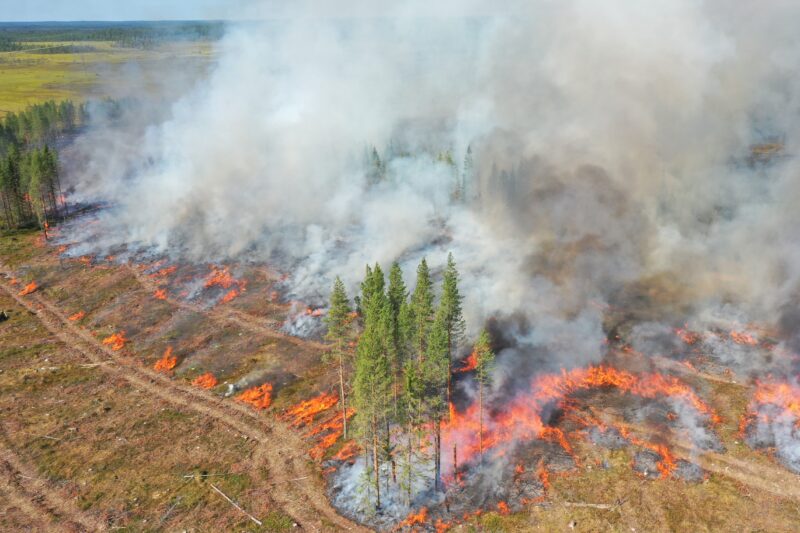
While Southern and Central Europe are battling wildfires, forests in Finland are being intentionally set on fire. Why are Finnish forests deliberately burned?
Wildfires are reshaping landscapes worldwide, pushing countries to rethink forest survival in a warming climate. Finland offers a rare counterpoint: it burns forests to revive fire‑dependent habitats, treating flames as restoration rather than threat.
In addition to drought and heat, according to the Natural Resources Institute Finland, one reason for the fires is that the volume of timber in European forests has doubled in 70 years. Forests have become dominated by conifers and have grown denser, creating conditions in which crown fires can spread rapidly.
In Finland, large and prolonged forest fires have so far been rare. The air here is cooler. The fragmentation of forest areas also limits the spread of fires – that is, there are numerous lakes, rivers, bogs, fields, and other open areas between and within the forests.
“We also have an effective firefighting system and a dense network of forest roads so that we can respond quickly to any potential fire,” says Forest Management Manager Tanja Oksala of Metsähallitus Forestry Ltd.
In Finland, considerable expertise has been developed in the controlled use and management of fire. Forests have been managed using slash-and-burn practices and prescribed burning for centuries.
In Southern Europe, prescribed burns are generally used to reduce flammable vegetation and thereby help prevent large, uncontrolled wildfires. In Finland, however, prescribed burning is more closely associated with biodiversity conservation and the restoration of fire-dependent habitats.
“We need active burning measures so that we can restore structural features similar to those created by wildfires and thereby promote the forest’s natural development,” says Oksala.
The objectives of prescribed burning have changed
Prescribed burning can be carried out for various reasons. Traditionally, it has been used to regenerate forests. In this case, after logging, logging residues, surface vegetation, and parts of the humus and moss layers are burned under controlled conditions.
“Burning reduces competition from ground vegetation. The temperature of the mineral soil rises because dark soil absorbs more sunlight, and light and heat conditions improve. Microbial activity in the soil increases due to the ash, and nutrient cycling improves,” Oksala explains.
Regeneration burns associated with forest management are now carried out less frequently than before, as more effective regeneration methods have replaced them. Most burns today are conducted for biodiversity conservation purposes.
“They are also generally prescribed burns carried out on regeneration areas, where logging residues and the humus or moss layer are burned. However, in these cases, it is not a problem if parts of the area remain unburned or the burn is incomplete.”
The main goal of prescribed burning for biodiversity conservation is to increase biodiversity in commercial forests. Burning produces charred wood that provides habitat for many fire-dependent insects, some of which are endangered. In addition, many fungi, lichens, and mosses benefit from prescribed burning.
“The greatest benefit of prescribed burning is that it changes the species composition and ecological conditions across the entire burned area at once,” says Oksala.
Prescribed burning for biodiversity conservation also includes burning retention tree groups. These groups consist of trees of different ages left standing in regeneration areas during logging to support biodiversity, along with the surrounding vegetation.
They can be carried out either in connection with a prescribed burn on a regeneration area or as separate burns. In the latter case, a sufficiently large group of retention trees is left on the logging site during harvesting, in a location where it can later be burned under controlled conditions.
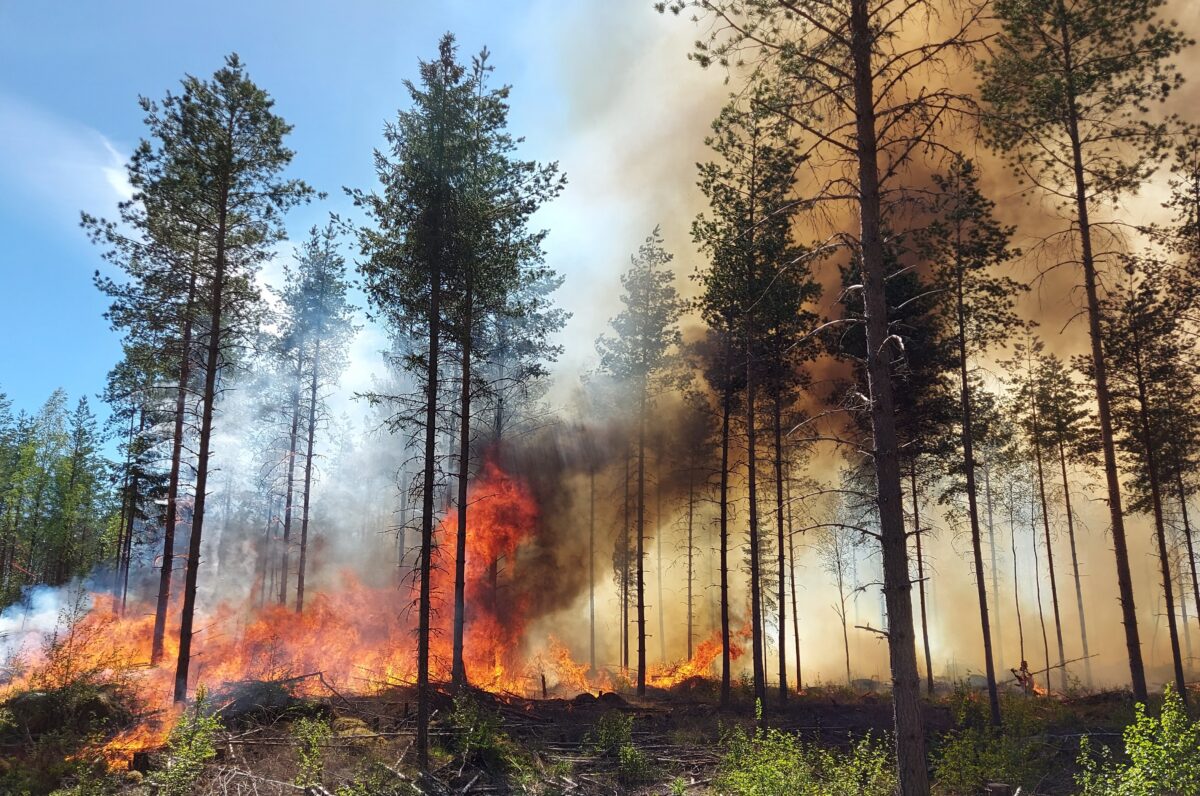
Burning is also carried out for forest restoration. Restoration burns are usually carried out in protected areas. Their purpose is to restore structural features, such as those created by natural wildfires, and to increase the amount of burned and charred wood. In addition to the ground layer and understory, living trees are also burned during restoration burns.
Prescribed burning requires careful planning
In Finland, Metsähallitus is one of the largest operators of prescribed burns. In 2025, it carried out burns on over 600 hectares of state-owned multiple-use forests. The organisation’s annual figures for different types of burns also include wildfires.
Private forest owners may also conduct prescribed burns on their own land. However, prescribed burning must always be carried out under the supervision of a forestry professional familiar with the practical aspects of the work, and the fire department must be notified in advance.
Carrying out prescribed burns requires extensive preparation and personnel. Efforts are made to conduct prescribed burns away from residential areas, but if homes or vacation homes are nearby, residents must be notified in advance.
Planning firebreaks and water sources is an important part of the preparatory work. The area to be burned should ideally be located near a body of water. Pine-dominated forests growing on mineral soils are particularly suitable for prescribed burning. Prescribed burning is not carried out on peatlands because the fire can smoulder in the peat for a long time. Dry peatlands also contributed to the spread of wildfires in France, for example, during the summer.
“For safety reasons, the area should have clearly defined boundaries so that the spread of the fire can be better controlled. The terrain must also be considered. For example, the area should not have very steep slopes so that water can be pumped into the area, if necessary,” Oksala explains.
Prescribed burns are conducted during wildfire warnings
The prescribed burn supervisor must closely monitor weather conditions in advance and ensure that sufficient personnel are available on site, even if the burn timing changes. Conditions need to be sufficiently dry for the fire to spread as intended.
“Prescribed burns are often carried out when a wildfire warning is in effect, because dry conditions make it possible to achieve the desired result.”
According to Oksala, the burn itself usually takes one day, while the preparatory work takes at least another day or two. After the burn, the site is monitored for several days to ensure that the fire does not reignite.
Prescribed burning promotes biodiversity and creates habitats for fire-dependent species. But can it also cause harm?
“There is, of course, always a risk that the fire could escape. Burning can also cause smoke pollution and affect water bodies, as nutrients may be released more readily. In the short term, prescribed burning also generates carbon emissions,” Oksala says.
“Despite this, I believe the benefits of prescribed burning outweigh the drawbacks.”