Finnish timber competitiveness strengthens as wood construction targets industrial growth

According to Jussi Noponen, Director of Metsä Wood, Metsä Group’s engineered wood products business, the competitiveness of Finnish saw logs is improving in international markets. He noted that wood construction is increasingly targeting growth in sectors such as data centres, industrial halls, and public buildings.
Speaking to journalists in Äänekoski, Finland, Noponen said that the availability of high‑quality saw logs in Central Europe has weakened. In his view, this strengthens the global position of Finnish wood raw material, as high‑quality logs are becoming less accessible elsewhere than before.
“Also, the demand for northern softwood pulp remains stable, even though growth in the global softwood pulp market has turned into a slight decline,” Noponen said.
Wood construction seen as a major growth sector
Noponen emphasised that tightening emission‑reduction requirements in construction will increase demand for wood in the coming years. He highlighted wood’s renewable nature and its ability to store carbon throughout a building’s entire lifecycle.
“Buildings account for about one third of global greenhouse gas emissions. Carbon can be stored in wooden structures for the entire lifecycle of the building,” Noponen said.
In Finland, wood construction still represents only a small share of the market, particularly in apartment buildings. In Sweden, around 20 percent of apartment buildings are made of wood, compared to roughly two percent in Finland.
According to Noponen, this difference is largely due to the level of industrialisation in construction. Sweden relies more heavily on prefabricated wooden elements, whereas Finnish apartment buildings are still predominantly built on site.
Industrial wood construction improves productivity
Noponen estimates that industrial wood construction offers significant potential to improve productivity across the construction sector.
“Labour productivity is about ten times higher in industrial wood construction compared to traditional on‑site construction,” he said.
In his presentation, he referred to OECD assessments showing that construction‑sector productivity has stagnated since the 1970s. He also cited an Aalto University study indicating that up to 80 percent of work carried out on construction sites is inefficient.
Increasing the use of wood, he stressed, does not imply opposition to other building materials.
“There is talk of hybrid construction, where different building materials are combined in a purposeful way,” he said.
Noponen sees the greatest growth potential for wood construction in large‑scale projects such as data centres, industrial halls, and public buildings—areas where repetitive, standardised construction aligns with tightening carbon‑footprint requirements and growing sustainability expectations from investors.
“New wood products enable long spans and lighter structures.”
Metsä Group invests €300 million in Äänekoski
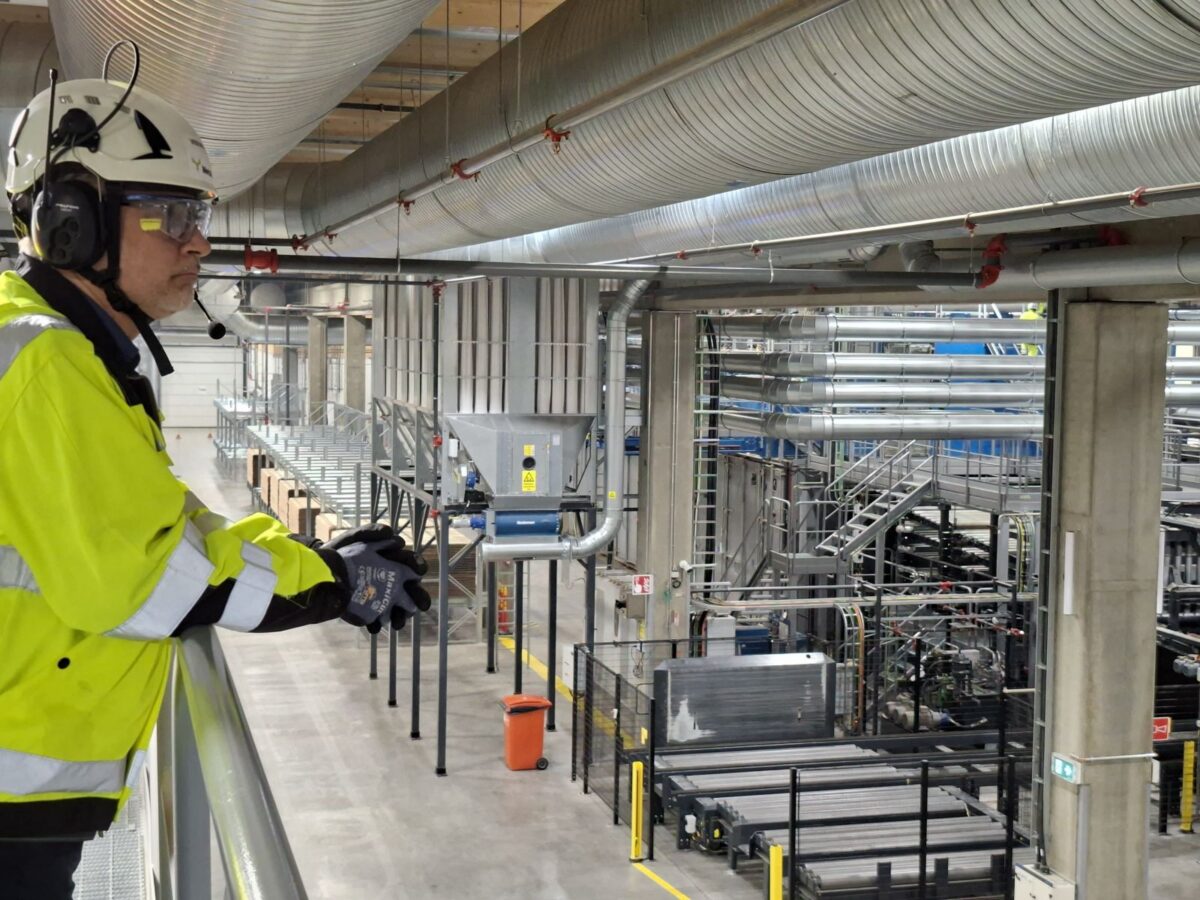
Noponen also highlighted Metsä Group’s new LVL factory investment in Äänekoski. The project valued at approximately €300 million is expected to employ around 130 people and increase the company’s LVL production by about 50 percent. Production is scheduled to begin in the autumn.
The company’s so-called Kerto LVL wood material is a softwood‑based laminated veneer lumber used in load‑bearing structures, roofs, floors, and wall elements. Metsä Group already manufactures the material at its mills in Lohja and Punkaharju.
In the construction sector, engineered wood products such as cross-laminated timber (CLT) and laminated veneer lumber (LVL), are considered as low‑carbon alternatives to concrete and steel. According to Noponen, LVL’s strengths lie in material efficiency and structural performance.
“With LVL, the same strength properties can be achieved with up to 50 percent less material compared to traditional construction solutions,” Noponen said.
He also noted that wooden structures store carbon throughout their lifecycle.
“Whereas one square metre of concrete floor causes about 105 kilograms of carbon dioxide emissions, a corresponding Kerto LVL structure can act as a carbon sink over its entire lifespan,” Noponen said.