Northern Scots Pine Supports Europe’s Power Networks – Green Transition Drives Demand for Wooden Utility Poles
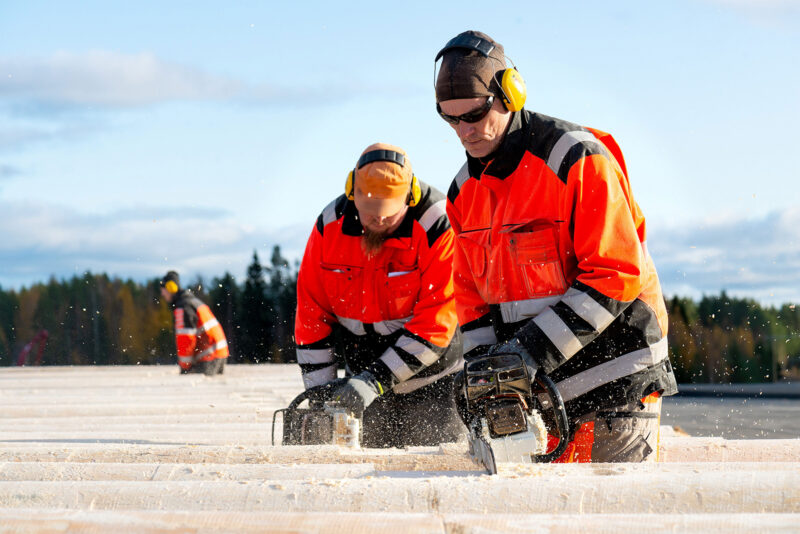
Europe’s rapid electrification is fuelling demand for a surprisingly traditional forest‑industry product: the wooden utility pole.
As Europe expands its power networks to integrate renewable energy, support growing industrial loads and connect new data centres, wooden poles are once again in high demand.
“Europe’s growing demand for electricity requires more power grids. As new networks are built and old ones renewed, this is also driving demand for wooden utility poles,” says Janne Partanen, Forest Director at Scanpole Oy, Europe’s largest manufacturer of treated utility poles.
The drivers of growth are well known: the expansion of wind and solar power, rising electricity consumption in industry and digital infrastructure, and the electrification of transport. All require new transmission capacity and more robust distribution networks.
The European Commission aims to double electricity’s share of final energy consumption from today’s 23% to 46% by 2040 — a shift that will require massive investment in grid infrastructure. While underground cabling is expanding, overhead lines remain essential across much of Europe, and wooden poles continue to play a central role.
Demand is growing across Europe
As wind farms, solar parks and data centres come online, the electricity they generate must be transmitted to centres of consumption. According to Partanen, this is already reflected in rising demand for wooden poles in many European countries.
An IndexBox market study estimates that the EU wooden utility pole market will grow by around 2–4% annually between 2026 and 2035. Modernising ageing networks and integrating renewable energy into the grid are the main drivers.
The study suggests that the EU requires around 2–2.8 million new wooden poles each year, with the total installed stock expected to exceed 190 million. Replacement of ageing infrastructure accounts for roughly two thirds of annual demand.
“A large part of Eastern Europe’s power networks dates back to the 1960s–1980s, and these networks are reaching the end of their technical service life. Modernisation is particularly needed for overhead networks, which have not been undergrounded at the same pace as in Western Europe,” Partanen says.
Demand has been particularly strong in the UK and Ireland, where wooden poles remain a core component of electricity distribution. In Central Europe, renewal of ageing grids and investments linked to renewable energy are driving growth.
“For example, Germany still uses wooden poles in overhead electricity and telecommunications networks,” Partanen says.

New alternatives to creosote
The IndexBox study also highlights a shift in wood‑preservation technologies. The share of alternative treatment methods, such as copper‑based preservatives, is expected to rise to more than 30% of new poles by 2030. In 2020, their share was less than 15%.
Creosote has protected utility poles for more than a century, shielding wood from moisture, fungi and insects. But its use has been increasingly restricted due to health and environmental concerns. Since 30 April 2023, creosote‑treated utility poles may be placed on the market only in EU countries that permit their use.
Norway, for example, was removed from the European Chemicals Agency’s list of countries allowing creosote‑treated electricity and telecommunications poles in October 2023.
Demand for larger‑diameter poles is rising
Changing weather conditions are also influencing the type of timber required.
“Many customers have started asking for larger‑diameter utility poles. This is partly due to more extreme weather conditions and the need to improve the resilience of power lines in storms,” Partanen says.
Finland’s forests can supply suitable timber, but more raw material is needed.
“We are constantly looking for more suitable timber. This offers forest owners a somewhat less well‑known opportunity: a large, high‑quality Scots pine can end up as a utility pole instead of being used as saw timber,” Partanen notes.
Scots pine suitable for utility poles grows in ordinary managed forests — often in the same stands that produce high‑quality sawlogs.
“Where you find good‑quality Scots pine sawlogs, you will usually also find good‑quality pole timber,” Partanen says.
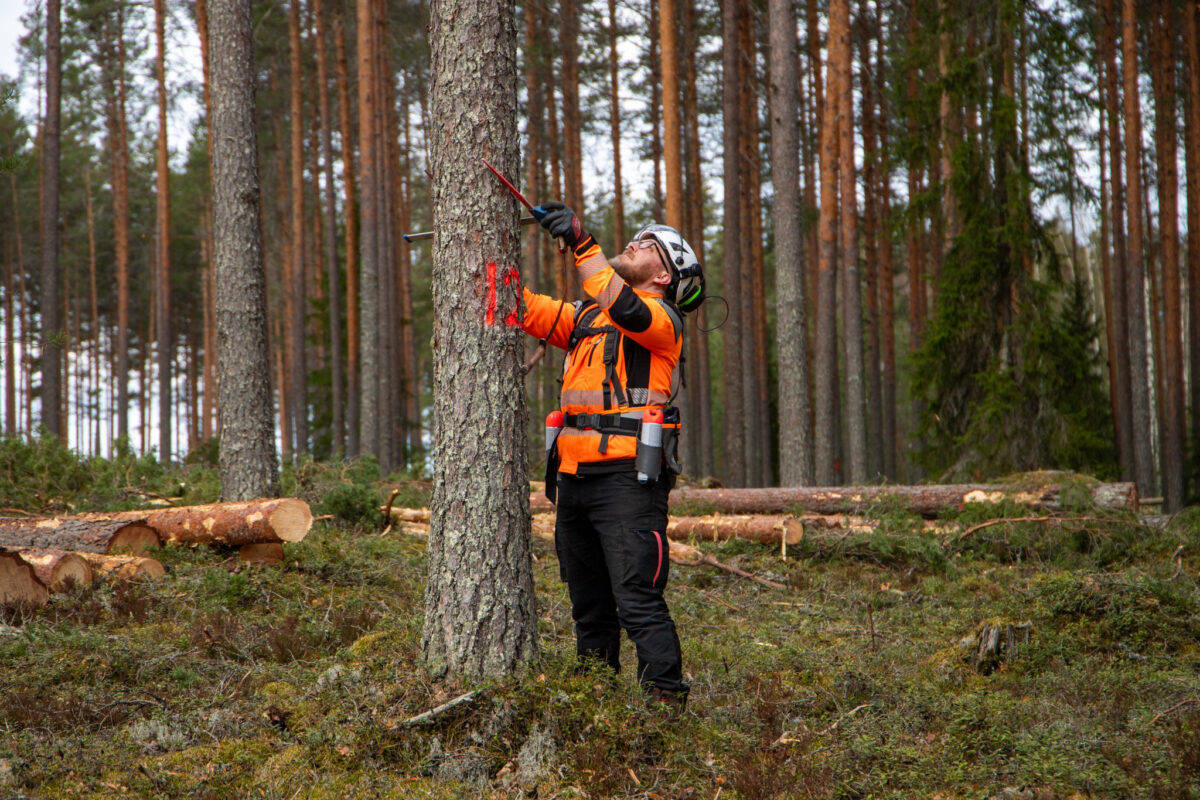
Only straight, high‑quality stems that meet strict dimensional and quality criteria are suitable. Pole lengths range from eight metres to as much as 24 metres. The requirements are largely similar to those for sawlogs: significant bends, cracks, multiple sweeps, butt rot and large branches can disqualify a tree.
Site conditions matter greatly. On nutrient‑poor soils, Scots pine develops slowly, forming thin branches and naturally straight stems — exactly the qualities required for pole timber. On richer soils, the trees grow faster and produce heavier branching, which can limit their suitability for use as utility poles.
“Some of the best pole‑timber forests are located in Central Finland, North Karelia and Kainuu — a region in northeastern Finland,” Partanen says.
From forest to export takes up to two years
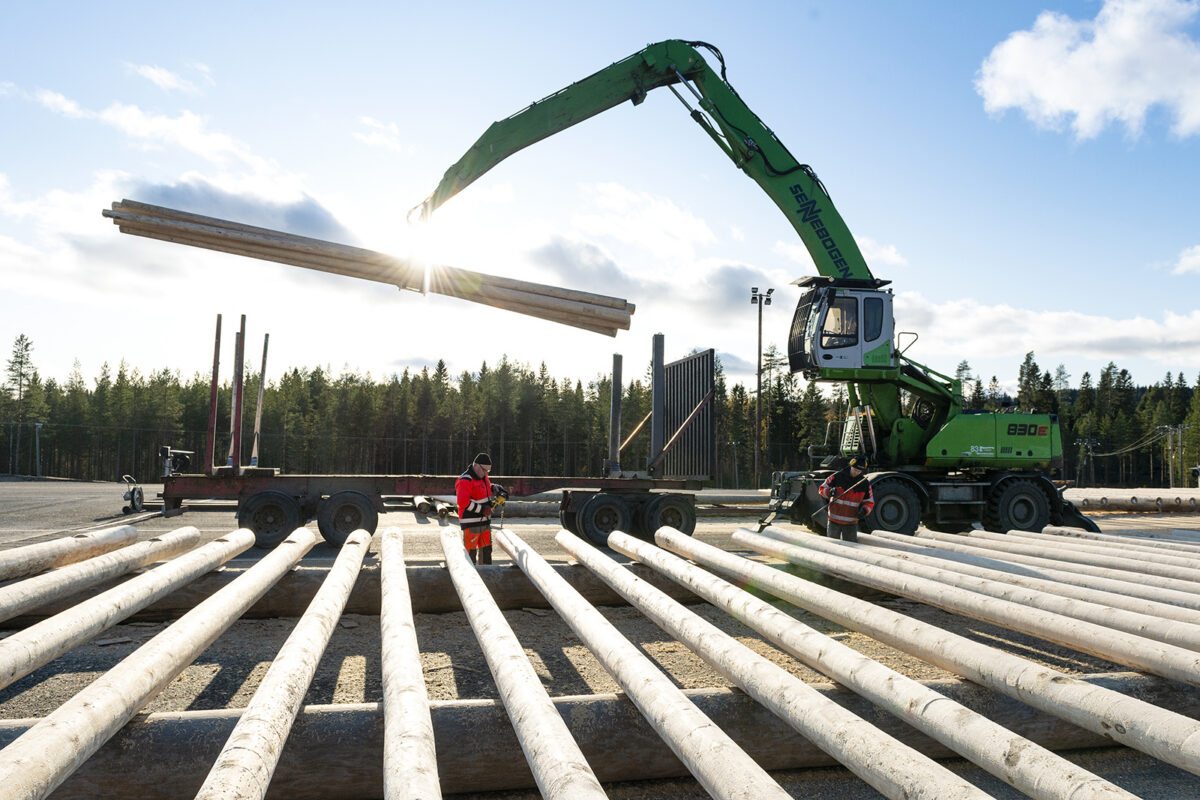
Utility‑pole timber is typically harvested in winter. After felling, the trees are transported to a production facility, where they are debarked and processed.
The wooden poles then undergo a long drying phase, mainly air‑drying outdoors in well‑ventilated stacks for around a year. Once dry, they are inspected, machined to meet the customer’s specifications and treated with preservatives.
“The entire process from forest to finished export product typically takes one to two years,” Partanen says.
Preservative treatment is critical. The agent must penetrate deeply enough to ensure durability in demanding weather conditions.
“A properly treated wooden utility pole can have a service life of more than 50 years,” Partanen notes.
Multi‑million‑euro investment in Finland to meet rising demand
Growing demand is reflected in Scanpole’s production. The company operates five production facilities: two in Norway, one in Wales, one in Ireland, and its largest plant in Finland, located in the village of Höljäkkä in Nurmes.
Scanpole recently invested around €10 million in the Höljäkkä treatment plant, including a new drying facility completed this year and a modern treatment line.
“The investment is designed to remove production bottlenecks and increase the number of poles manufactured in Finland. As a result, our Finnish production capacity will rise significantly,” Partanen says.