EU moves to standardise packaging labels – what does it mean in practice?
Across the EU, packaging labels and recycling systems vary widely. New EU rules aim to standardise packaging labels, making it easier for consumers to sort waste correctly.
Today, the same type of packaging may even be sorted into different waste bins depending on the EU member state creating challenges for product manufacturers. Many EU countries currently use their own recycling symbols and instructions.
“These mandatory labels disrupt the EU’s internal market, as labels from different countries must be added to multinational packaging,” says packaging expert Heli Nykänen of Sense n Insight.
According to Nykänen, the number of symbols and instructions has grown so large that “there is a risk of running out of space on packaging.”
The planned reform of packaging labels is part of the Packaging and Packaging Waste Regulation (PPWR, EU 2025/40). Its goal is to harmonise labelling across the EU, clarify sorting instructions for consumers, and ensure that packaging ends up in the correct waste stream.
Mandatory recycling labels are scheduled for introduction by 12 August 2028, provided the implementing regulation proceeds as planned.
“However, the timeline is subject to change; at this point, we cannot say anything specific about it,” notes Nykänen. “Once the final decision is made, there will be a 24‑month transition period.”
“Although the core of the new system is the material used to determine the labels on the packaging, the most important thing is that the labels show consumers where to dispose of the packaging material,” Nykänen explains.
When the same label appears on both the packaging and the recycling bin, consumers will be able to sort waste more intuitively and consistently.
“In this case, the differing recycling systems across EU Member States will not complicate individual consumers’ sorting behaviour,” says Nykänen.
New recycling labels aim to bring clarity across Europe
Cardboard packaging recycling works well in Finland, but at the EU level the situation varies: recycling systems, practices, and even the colours of recycling labels currently differ from one another.
“In some countries, when recycling composite packaging containing both cardboard and plastic, packaging with lower fibre content is collected separately from packaging with high fibre content,” Nykänen explains.
The proposed new labels take this into account, but in a way that allows consumers to follow the same principle: return the packaging to a waste bin marked with the same recycling symbol.
“Since there is currently no requirement in Finland to include any kind of recycling labels on packaging, there is no common standard, and the labels are inevitably inconsistent. It can be difficult for consumers to determine which instructions are correct and comparable,” Nykänen says.
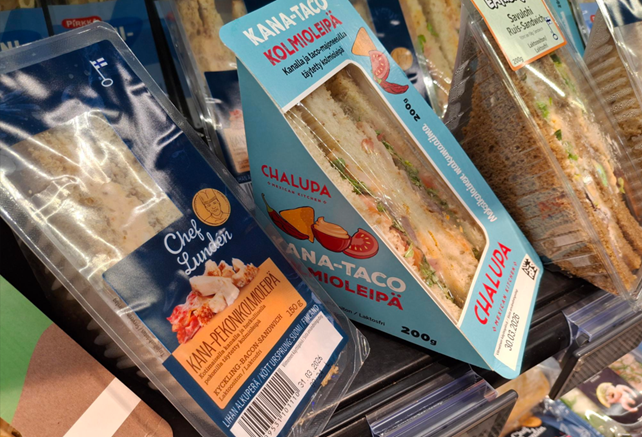
For example, consumers have often wondered whether a triangle sandwich box or paper bag with a plastic window should be placed in mixed waste because of the window, or whether the materials should be separated or placed entirely in cardboard recycling.
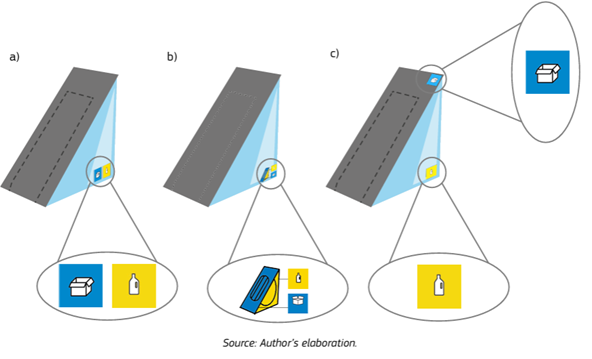
According to Nykänen, the upcoming labels will clarify this. If the packaging has a separate recycling symbol for the plastic part, that part should be removed and sorted separately. However, if the label indicates only cardboard or paper recycling, the window is also acceptable in that category.
Clarity of labels and consumer communication are key
According to Nykänen, the new symbols are designed to be visually easy to understand and to correspond to the markings on waste bins.
“An important goal here is that the packaging and the waste bin have the same marking.”
Packagers must know the materials used in their packaging and apply the correct label. Consumers then simply follow the instructions.
Consumer behaviour has been a major focus in preparing the reform. The labels have been extensively tested, and the goal is to provide consumers with the right information at the right time. Studies have also highlighted the importance of visual cues. At the same time, it became clear that the system cannot solve everything.
“Colour supported sorting slightly more effectively than text,” Nykänen notes. “However, the labelling system cannot provide complete and context‑specific sorting guidance.”
According to Nykänen, developing the labels has required balancing simplicity and accuracy.
“The label must be as simple as possible and as complex as necessary for clarity,” she summarises.
Everyday example: triangular sandwich packaging
A triangular sandwich box made of multiple materials illustrates how future recycling labels will work. The box may be entirely plastic, or it may consist of a cardboard base and a plastic lid. In some cases, both the box and the lid are cardboard, but the lid includes a plastic window.
According to Nykänen, under the current proposal, recycling labels can be placed on the packaging’s primary material, indicating which label corresponds to each part. Another option is to place a separate label on each component.
“This latter method would ensure that consumers can see, even from the separate parts of the packaging, where the product is ultimately placed,” Nykänen says.
Labels pose practical challenges for companies
The reform will mean significant practical changes for companies. As a rule, all consumer packaging will fall under the labelling requirements.
However, uniform labelling also benefits the internal market:
“When the same labelling is used on packaging and in waste bins across the entire EU, there is no need to include separate recycling instructions for each country on the packaging. This simplifies logistics and packaging design for companies,” Nykänen emphasises.
Still, the success of the reform depends not only on labels and regulations; communication and consumer guidance will play a key role in the rollout.
Finally, Nykänen notes that even though labelling is standardised at the EU level, national communication, guidance, and education remain essential.