Wood-based Kuura textile fibre saves water and chemicals
Uusi puu – The New Wood Project shows what wood can do. The project promotes wood-based innovations and provides information about them.
The clothing industry is one of the world’s biggest polluters. Textile production consumes enormous amounts of water and chemicals, and synthetic fibers contribute to microplastic pollution in waterways.
According to the WWF, producing a single cotton shirt can require up to 2,700 liters of water. This amount is equivalent to one person’s drinking water needs for almost 3.5 years. It is estimated that the clothing and textile industry accounts for up to 10 percent of global climate emissions, which makes the development of new biodegradable and recyclable materials crucial.
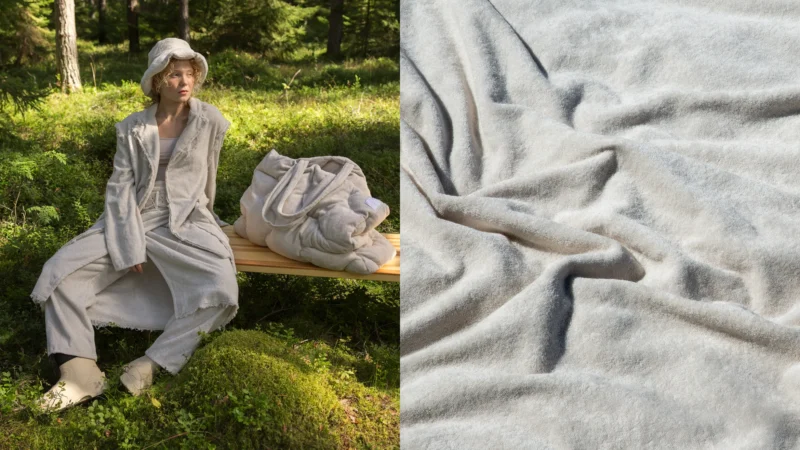
Kuura™ is a textile fiber developed by Metsä Group. Kuura fiber is made from softwood pulp produced at Metsä Group’s bioproduct mill in Äänekoski, with the wood raw material sourced from the forests of its owner members.
“With Kuura, we aim to offer an alternative to the growing demand for cellulose-based materials in the textile industry,” Metsä Group states on its website.
At the heart of the Kuura development project is a semi-industrial production facility (pilot plant) located in Äänekoski. The pilot plant was launched at the end of 2020 and has a nominal capacity of approximately one ton per day.
In 2024, Metsä Group conducted a new life-cycle assessment (LCA) of Kuura® textile fiber. The evaluation, based on a hypothetical industrial-scale factory producing 100,000 tons of Kuura® fiber per year, was conducted by Etteplan, an external expert organization.
The assessment shows that Kuura’s global warming potential (GWP100) is less than one-third of that of viscose. According to the study, viscose, which is also made from wood, is the second-best option in terms of climate impact.
The Kuura textile fiber project is currently in the testing and development phase, with the fiber being developed by Metsä Group’s innovation company, Metsä Spring.
“Metsä Group’s goal is to bring a new competitive textile fiber product to the market. Environmental impacts, and in particular the potential to mitigate climate change, are among the key indicators. We are very pleased with the assessment carried out by an external expert. It shows that our chosen concept has great potential for success. This gives momentum to further development,” says Niklas von Weymarn, CEO of Metsä Spring.
The success of Kuura fiber can be explained by the fact that its industrial production would be integrated with Metsä Group’s bioproduct mill, which does not use fossil fuels. The bioproduct mill is energy self-sufficient, meaning that it produces more renewable energy than it consumes. A potential Kuura mill would utilize this surplus energy. The company is now planning a large textile fiber factory in Kemi, which would create an estimated 250 new jobs. The factory would produce approximately 100,000 tons of Kuura fiber annually, equivalent to up to 170 million T-shirts.
In addition to the LCA results, Kuura textile fiber has also received good results since 2021 in the Hot Button Ranking assessment published by the Canadian non-profit organization Canopy. In addition, Kuura has received the “Green Shirt” rating four times in a row, which requires a risk-free and transparent supply chain and traceability of raw materials.
Kuura textiles received significant media attention on November 27, 2025, when EU Commissioner Jessika Roswall appeared at the EU Bioeconomy Strategy launch event in Brussels wearing a wood-based Kuura dress.